

Introduction
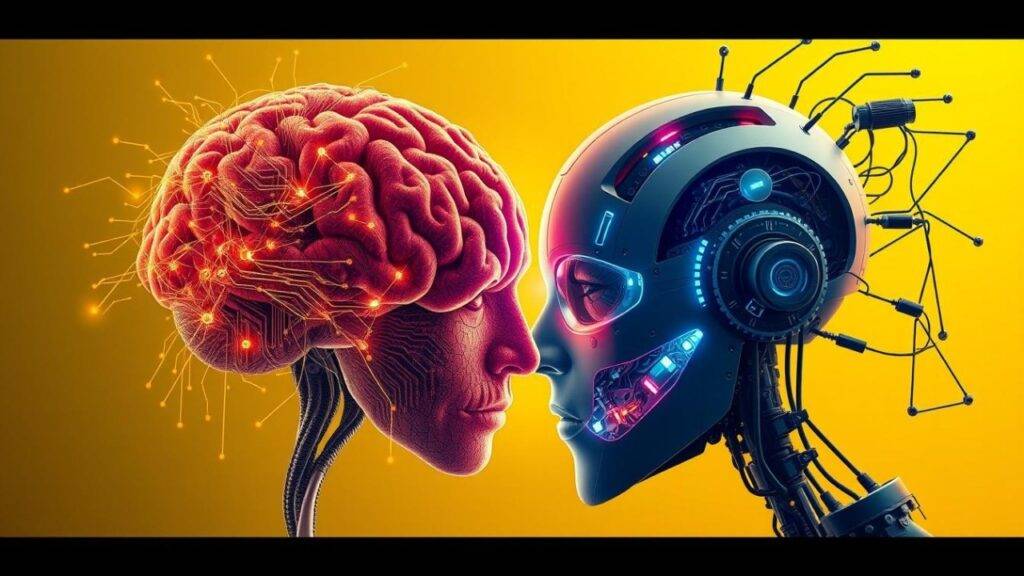
Both human intelligence and artificial intelligence are capable of learning, solving problems, and making decisions; however these two forms of intelligence operate differently.
Human intelligence is based on the brain and includes creativity, emotion, intuition and experience and therefore provides a means for individuals to grow and adjust to new and unknown situations. In contrast, artificial intelligence is created by humans using codes that create algorithms to apply various types of data and automate certain processes.
Artificial intelligence is capable of analyzing large quantities of information quickly and performing consistent activities without physical fatigue, however, it is devoid of empathy, morality or the ability to create original ideas and thoughts. While humans may be slower at processing information, their strengths are in using creative and empathetic thinking and making good judgments. Understanding the distinctions between human intelligence and artificial intelligence allows us to better understand the strengths of both types of intelligence.
Artificial intelligence provides the capability for automated complex calculations and data analysis by humans, while humans bring emotional insight, moral reasoning, and innovation to the workplace.
Therefore, the relationship between artificial intelligence and human intelligence is reshaping how we do things in our current world, to become more efficient, more productive, and more connected.
How Humans Think
Thinking is a complicated process for humans that includes a combination of their brains, emotions, experiences, and social interactions. Whereas machines rely primarily on logic and data, humans use a blend of reasoning, intuition, memory, and creativity to form their understanding of the` world and make decisions.
To solve a problem, humans’ brains process information by looking back on previous experiences and making predictions regarding future events and outcomes based on potential consequences of their actions. Because of this ability, they can adapt to ever-changing environments, address unexpected challenges, and be creative and imaginative in their thoughts and ideas.
In addition to the processing of information by the brain, emotions are a significant factor in human thought processes. Various emotions, such as happiness, fear, empathy, and anger, can have an impact on the decisions people will make, what they consider important, how they solve problems, and how creative they become.
The brain is also capable of retaining memories of prior experiences, allowing humans to learn from their experiences and innovate and create new ideas.
Through social interactions, humans can communicate with each other, work together, and learn from each other. Values, beliefs, and educational background have significant effects on how humans view the world and think about various issues.
Consequently, humans can think flexibly, adaptively and are profoundly affected by both internal and external forces and factors, which provides them with the ability to understand complicated, uncertain and/or abstract things far more effectively than machines.
How AI Thinks
Unlike Human Thought Processes- Artificial Intelligence (AI) handles tasks with data, mathematical models and algorithms instead of with “thinking” or “understanding“.
AI can process large quantities of information and use patterns it has created from previous experiences to help it make choices.
When an AI is assigned a particular task, the way that it will approach this task will depend upon whether it was programmed with explicit instructions by a developer/programmer or whether it was given “data” to train on and will utilize those historical data to predict what would be the best course of action going forward
There is no emotional (“feeling”) element to an AI, and there is no consciousness (I’m trying to explain this without using a lot of jargon).
Machine Learning is an example of an artificial intelligence system that is learning through machine learning techniques (from examples), or through experience (from results).
For example, when an AI is developed for image recognition, it is trained on many thousands of images with identifying labels showing what those pictures are so that it knows what common features exist within those types of pictures to perform properly at recognizing items..
When making decisions, AI bases this decision-making upon “statistics” and “logic.” AI lacks the ability to know “meaning,” “context” or “ethics” of data, so it does not make decisions based on “feelings” or “instincts.”
AI makes “fast, consistent” and “data-driven” decisions based upon models that are developed and constructed by people, using their input of high-quality data and clear security policies on the objectives for that specific AI model.
Strengths of AI
Several advantages make Artificial Intelligence very useful in the field of technology, and everyday life. One advantage is speed – with the ability to process vast amounts of data in mere seconds, AI operates at a rate thousands of times faster than humans.
Therefore, it is suited for both Data Analysis, Pattern Recognition, and Real-Time Decision Making. Another advantage of AI is its high degree of accuracy and consistency, therefore minimising human error when performing Medical Diagnoses, Financial Analyses, Quality Controls etc.
One great strength of AI is its ability to continuously operate without suffering from fatigue. This means that unlike humans, AIs may operate around the clock, thereby being ideal for Applications such as Automation Systems, Monitoring Systems and Customer Support Chatbots.
AI’s ability to complete repetitive and complicated tasks frees Human Workers to be able to devote more time and energy to Creative and Strategic Work. Over time, as ai processes more data, it becomes better (through Machine Learning Algorithms) and more effective.
Another great strength of AI is its scalability – it is possible for one AI program to perform tasks in a large number of locations.
To summarise, AI has many advantages, including speed, efficiency, accuracy and data-driven results – thus AI provide a reliable solution and help people do their jobs more effectively in a variety of fields.
Limitations of AI
Artificial Intelligence possesses many strengths, but there are several weaknesses that must be noted. For example, AI lacks human emotional intelligence, creativity and intuition, which are necessary for making many real life decisions. AI cannot accurately process feelings, value assessment or moral judgement because it is not a human.
AI only has the ability to function according to the rules defined and based upon the data given it so it has no independent thought or ability to be innovative like humans.
Additionally, AI is reliant upon data quality in its operation. Therefore, if the data used to train an AI system is biased, incomplete or incorrect, then any outputs produced by the AI will also be biased and inaccurate.
AI does not have the ability to apply “common sense” and cannot always establish the proper context for a situation so an AI system may perform poorly if it encounters an unexpected or more complex scenario than a human would have been able to process accurately.
AI development and support require a significant amount of investment; therefore, as well as requiring extensive infrastructure to support an AI system, companies require personnel with specific expertise and experience in the fields necessary for AI development, as well as continual updating of their AI systems.
Finally, privacy and security concerns associated with using large databases containing personal information also exist in light of the increased amounts of data that AI requires to operate.
Moreover, AI’s capabilities to replace a human workforce will ultimately result in job loss for humans due to the potential for automation of specific jobs by AI. While AI has the potential to perform at high levels, as of yet, it cannot replicate human intelligence, and therefore requires human judgment along with responsible and careful use of such technologies.
Can AI Replace Humans?
AI is growing at an exponential rate; it can perform a multitude of functions traditionally done by humans. AI applications include the ability to work almost instantaneously when it comes to data analysis, customer service, manufacturing, and automation; AI can also analyze data almost instantaneously, providing improved efficiencies due to reduced errors.
Therefore, many workers are concerned that their jobs may eventually be eliminated in favour of AI. However, it’s unlikely that AI will replace humans altogether. Instead, AI will probably only replace many of the specific tasks that humans perform.
While AI will have a huge advantage when it comes to repetitive, rules-based, and data-intensive tasks, AI will struggle to perform tasks requiring creativity, emotional perception, morals, as well as complex interaction with other people and organizations.
Humans possess qualities that cannot be replicated by AI, including empathy, imagination, ethical reasoning, and creativity when faced with uncertainty.
Additionally, many leadership-style jobs rely on developing emotional intelligence and critical thought. In this respect, AI may be viewed as a tool that will support people in accomplishing their work by freeing them from the burdens of repetitive tasks and offering insights based on data.
Moving into the future, it is anticipated that both humans and AI will collaborate in an efficient manner—machines will generate efficiencies, while people will utilize their creativity, strategy, and decision-making capabilities. By acquiring new skills and adapting to emerging technologies, humans will be able to continue playing their vital role alongside AI.
These post is also worth reading:
What Is Artificial Intelligence and How It Works
AI Myths and Facts You Should Know
How AI Tools Improve Productivity
Technology Trends That Will Shape the Future
Artificial Intelligence vs. Human Intelligence by

Conclusion
The unique advantages and disadvantages of artificial intelligence (AI) and human intelligence are complementary. AI has greater speed and accuracy than humans as well as the capability to process larger amounts of data. Therefore, AI is particularly good at performing repetitive and technical tasks; conversely, human intelligence is premised on human creativity, emotion, intuition, and moral decision-making—qualities that AI does not possess.
While there will be many areas of work in which AI will displace specific tasks or roles that humans currently perform, AI will not replace humans entirely. Collaboration between humans and intelligent machines will become increasingly common; intelligent machines will enhance human intelligence and human creativity will help shape the intelligent machines.
As AI becomes more prevalent, we will continue to use it wisely and adjust our behaviours to technological changes to ensure that we continue to working side by side with these intelligent machines into the future.



Pingback: Understanding How the Internet Works in 7 Easy Steps
Pingback: 7 Incredible Ways AI Is Transforming Daily Life
Pingback: 7 Shocking AI Myths and Facts You Must Know in 2026