

Introduction
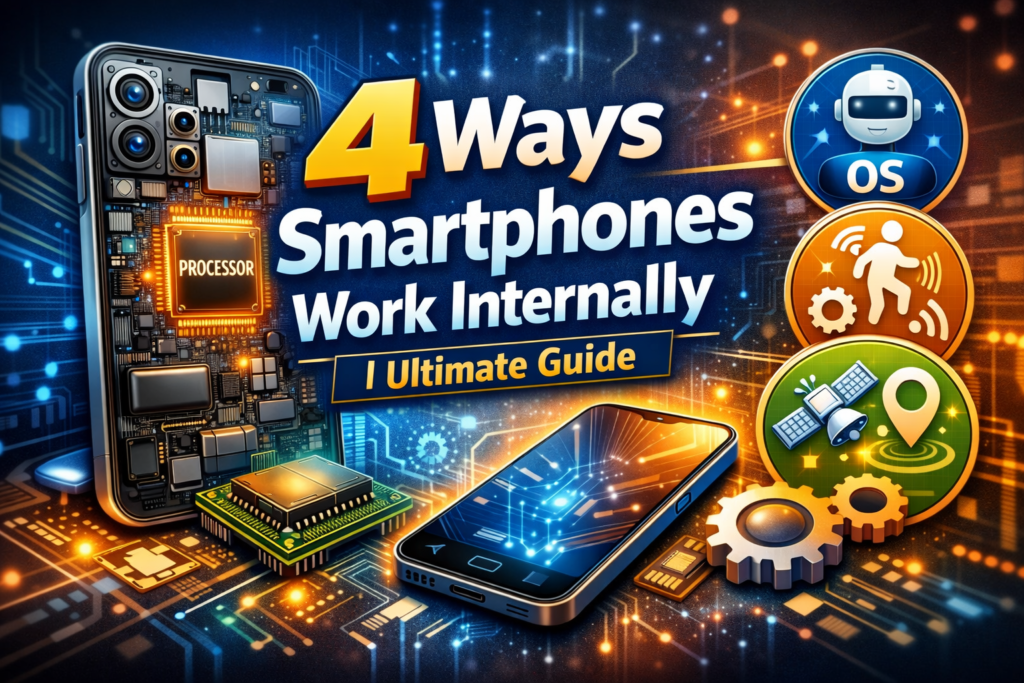
Smartphones are a convergence of different technologies, all fit into one highly portable device. They often appear to be easy to operate from the outside; however, the internals of a smartphone contain many advanced components that must work together efficiently to create a well-performing experience.
Users can gain insight into the technology that is used to facilitate some common activities like sending and receiving text messages, placing phone calls, accessing the internet, etc., when they learn about how smartphones operate internally (what components are inside, etc.).
A smartphone has a processor (CPU), memory (RAM), storage, battery, sensors, and display screen; all of the smartphone’s components must work together as a team with its operating system (e.g., iOS or Android) for the app to function perfectly.
This article will describe how a smartphone operates on the inside and include details about the main hardware components, communication between those components, and how all of these components function with the aid of software to allow for the functionality of a smartphone.
With this knowledge, smartphone users will have a better understanding of the technology they use daily and will be able to make more educated decisions regarding the use, maintenance, and expansion of their smartphones. Smartphones are more than just communication tools—they are also compact computers that pack an incredible amount of power into a small device that can be carried around easily.
Processor Basics
Transforming Information About Key Elements of a Processor
Modern processors are formed from a highly complicated “System–on–a–Chip” (SoC) that relies on many core functions. Below is an explanation of these core functions:
Control Unit (CU) – Consider the Control Unit to be a manager of all components in a CPU, controlling the process of getting instructions from memory to the CPU and translating that instruction into a command that tells other parts of the system what to do.
Arithmetic Logic Unit (ALU) – The largest portion of the CPU, the ALU is basically a calculator; it performs arithmetic and logical operations on data that has been brought into the CPU.
Registers – Registers are very small parts of the CPU that store a small amount of temporary data and instructions being processed.
Cache (Levels 1, 2, and 3) – Cache in a processor consists of fast memory that is used to hold frequently accessed data so that it does not need to wait for slower RAM to retrieve its data.
Neural Processing Unit (NPU) – Many modern processors have an additional core, specifically the NPU, which is used to offload tasks related to AI (such as real-time background removal or real-time code completion) from the other CPU cores.
The Operation of a Processor (A CPU)
The Fetch-Decode-Execute cycle is a continuous loop that all processors perform when executing a program. The three cycles are:
Fetch – The CPU retrieves an instruction from memory.
Decode – The CU (Control Unit) decodes that instruction into a format that can be understood by the hardware.
Execute – During this cycle, the ALU or another unit executes the actual functions required by that instruction (e.g., doing mathematical calculations between two values).
Operating System
Data and performance in smartphones rely on the relationship between RAM (Random Access Memory) and storage.
RAM is a temporary memory type that temporarily stores the data and instructions needed to run apps on the device. Because RAM stores data temporarily, it allows users to open apps simultaneously without slowing down the device by providing access to current app data.
As a result, when switching from an Internet browser to a social networking app or playing a game, devices with more RAM are able to provide a better user experience.
Storage is the type of memory that stores all of an individual’s existing apps, data, photos, videos, and system files permanently. Unlike RAM, data stored in storage remains when the device is powered off.
The two main types of storage used in smartphones are eMMC and UFS (Universal Flash Storage), both of which affect how long it takes to load apps and files.
Both RAM and storage play an important role in how well a smartphone performs. Using RAM ensures that multitasking is performed seamlessly in real-time while storage stores user’s personal data for long-term use of the smartphone. Together they ensure that using a smartphone is as effective as possible.
Battery Management
Smartphones rely on battery management for optimal use of energy and long-term use of batteries in a safe and sustainable manner.
Lithium-ion and Lithium-polymer batteries are used in smartphones as they give a higher storage density, but they need to be protected and/or managed from being damaged through overheating, over-charging, and/or rapidly deteriorating.
Smartphones have both hardware and software components working together to manage battery usage, how much battery is left in the battery pack at all times, and how much power the phone uses by each feature (screen dimming and attaching to the Internet, etc.).
Adaptive battery management is a feature that periodically reduces the number of background processes running on a smartphone to enable the smartphone to conserve power by increasing its overall battery life. Power Saving Mode is another feature that conservatively reduces the size of your smartphone screen, thereby conserving power to extend your smartphone’s battery life.
Fast Charging and Wireless Charging technology use smart battery management systems to help regulate and safely control the flow of electricity into and out of the smartphones’ batteries.
Battery management is more than just keeping the phone charged and operating; it also safeguards the longevity of the smartphone batteries.
Sensors monitor the temperature and voltage of the phone’s battery and prevent the batteries from being harmed by excessive heat or electrical surges.
Efficient battery management systems ensure energy is delivered correctly to all components of a smartphone, including processors, display screens, and wireless communications modules, so that the smartphone is able to perform complex tasks without experiencing sudden shutdowns.
Ultimately, Battery Management combines hardware, software, and advanced algorithms in order to provide a reliable, long–lasting, and safe power supply to a smartphone so that it may last throughout the course of a day in an efficient manner.
Explore this related topic here:
Difference between Hardware and Software
How Technology Is Improving Modern Life
How to Learn Technology Skills Faster

Conclusion
Smartphones allow you to perform a larger variety of tasks than previous generations of cell phones; they have become a powerful combination of advanced hardware, software, and user interface(s).
Its components (processor, RAM, storage, battery, etc.) work together to allow for the efficient operation of both hardware and software, but the complexity of a smartphone is only understood when looking at the way it works internally.
Each component has a defined purpose and works under the auspices of an operating system to provide a smooth, efficient, and reliable experience for the end user.
As we learn how smartphones function internally, it helps us to understand the complicated relationships between hardware and software that allow for seamless mobile experiences when performing seemingly simple tasks such as making phone calls, sending texts, and accessing applications. Additionally, features such as processes (battery management system) and systems (security) help to promote a level of consistency and safety that enhances the total user experience of the smartphone.
As mobile technology continues to evolve, smartphones of the future will continue to offer users more processing power, energy efficiency, and improvements to intelligent energy usage through integrated artificial intelligence (AI), as well as continuing to receive faster processors and improvements in energy-efficient systems.
By understanding the way smartphone components work internally, consumers will be better positioned to utilize and maintain their devices properly and to maximize the benefits of the latest innovations in mobile technology throughout their daily lives.



Pingback: 7 Incredible Ways AI Is Transforming Daily Life
Pingback: 7 Powerful Software vs Hardware Differences in Computing