

Introduction
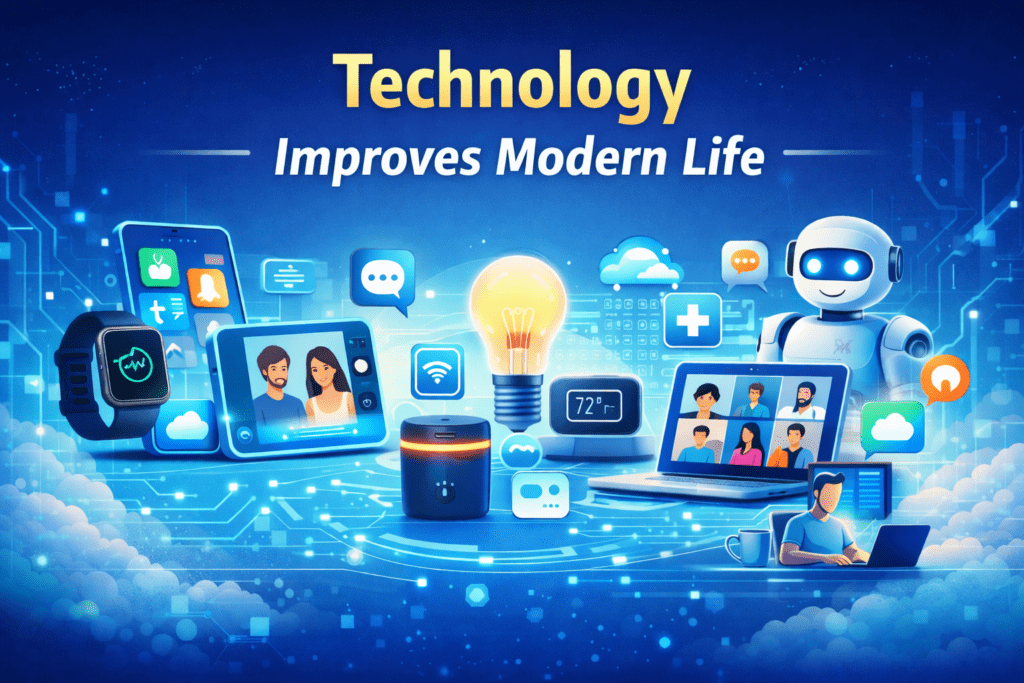
Modern life has been impacted by technology in almost every way you can think of – how we live, work and communicate.
The past few decades have seen the rapid advancement of technologies that have made it easier to accomplish routine tasks and to have access to those same tasks. Technology has facilitated the ease of daily life and has saved us all time – with everything from our smartphones and the internet to our AI and smart devices.
Communication has seen some of the greatest advancements due to technology.
Now, through video calls, text messaging and social media, we are able to stay connected with friends and family no matter where they are located.
Online learning platforms, digital classrooms and educational apps have provided students access to knowledge they’re otherwise unable to access, while the healthcare industry has also been improved through the use of technology, allowing doctors to identify illnesses and treat patients more efficiently with the use of telehealth, wearable technology and advanced medical equipment.
The workplace is now transformed due to the ability to work remotely, use automation and use digital collaboration tools, enabling companies to drive efficiency and serve customers in a more effective way, along with their ability to function in a global economy.
Technology in our everyday life has increased convenience and enables us to feel safe and secure, from online banking to shopping via eCommerce to GPS and smart home systems.
In summary, technology will continue to improve our daily lives by enabling us to be more productive, connected and live a better quality of life.
Communication Technology
Communication technology is a wide classification of all tools, systems, and processes used to create, send, store, and share information through digital and physical means.
From the beginning of the human race – the first time someone used smoke signals to communicate – to today’s advanced technologies like the internet, mobile phones, and social media, advances in communication technologies have streamlined and facilitated faster, more informed global communication and media transfer.
Definition: Any devices, applications, software, and infrastructure used to exchange information.
This includes simple devices such as the telephone, to much more complex systems such as fiber optics, cloud computing, 5G telecommunications networks, etc.
Function: Capture, process, store, retrieve, analyze, and transmit data (text, audio, and video).
Connectivity: Build, create, and facilitate real-time team collaboration within and throughout the world; help minimize information management chaos by facilitating how people access, find, organize, and retrieve information.
Types of communication technologies include:
Wired (telephone, Ethernet, and fiber optics) and wireless (3G, 4G, and 5G Cellular, Wi-Fi, a- nd- satellite).. Digital platforms (i.e., the internet, social media, email, and – – video conferencing)..
Devices (computer, mobile/smart phone, smart devices, and tablet).
Impact
Social: Instant communication across any distance cr- – eates global communities..
Economic: Increasing business efficiency through e-com- – merce and digital development..
Education: Facilitate online learning and research.
Information technology (IT) and communication technologies (ICT) are terms that are used to describe the same concept.
Education Technology
Medical technology encompasses a range of equipment, instruments, and creative strategies to support healthcare in enhancing the diagnosis, treatment, and delivery of patient care.
Today’s advances in medical technology have changed how we provide healthcare, increasing the speed, accuracy, and accessibility of many different aspects of a healthcare system. Technology enables physicians and other healthcare providers to care for patients safely and efficiently, including innovative means of diagnosis and treatment.
Examples of technology that have improved the accuracy of diagnosing and treating illnesses are diagnostic equipment such as MRI machines, CT scanners, ultrasound machines, and blood sample analyzers, which allow physicians to determine the presence and nature of disease very early in the course of an illness.
In addition, telemedicine has become a critical component of modern healthcare, allowing patients to receive care at a distance using digital methods such as video conferencing and web-based systems.
Additionally, wearables such as fitness watches and fitness bands track heart rates, sleeping patterns, and activity levels, thus empowering the public to make more informed choices about their own health and warn providers of potential health concerns.
Technology plays an important role in a host of other areas, including robotic-assisted surgical procedures, electronic health record (EHR) systems, and artificial intelligence (AI) in healthcare, which increase the accuracy of treatment methods, eliminate many sources of error in practice, and facilitate workflow in hospital clinics. All of these technologies create time savings, lower costs, and lead to improved patient satisfaction.
Smart Homes
What Makes Smart Home Automation Possible
Device Connectivity:
Most smart home devices wirelessly connect to a network via Wi-Fi, Bluetooth, Zigbee, or Z-Wave.
Centralized Hub:
Centralized smart home hubs (like Amazon Echo, Google Nest Hub, or Apple HomePod) combine various apps into one place and typically serve as the control center for everything else.
Home Automation:
Scheduled automation (e.g., lowering the lights at 10 p.m.) and device interaction with sensors (e.g., unlocking the front door when you have your smartphone within range) are part of smart home automation.
Smart Device Connections:
Standards like Matter were established in order to allow for easy interoperability between devices from multiple manufacturers (e.g., Apple, Google, and Amazon).
Common Features of a Smart Home:
Home Security Solutions:
Ring video doorbells, smart locks, and security cameras provide real-time monitoring and remote control capabilities.
Green Home Climate Solutions:
Google Nest and Ecobee smart thermostat use the user’s behavior patterns to create energy-efficient heating/cooling schedules.
Smart Lighting:
Philips Hue smart bulbs can be dimmed, change colors, or be set to turn on and off using a smartphone or web app.
Smart Kitchen and Laundry Appliances:
Smart refrigerators track food inventories, while smart washers and dryers can be controlled from anywhere in the world or through scheduled operation during low-cost energy times.
Future Trends
I hope you have been enjoying reading my blog and look forward to continuing to share my passion with you.
Technology and Artificial Intelligence
Emerging Technologies: The application of Artificial Intelligence to the physical world is a significant trend. Humanoid robots are expected to be an integral part of households and the use of autonomous technologies to support manufacturing operations, including the implementation of autonomous vehicles in manufacturing environments.
Overview of Nations Developing Sovereign AI: Countries are focused on creating data “islands” to mitigate geopolitical risks and establish digital sovereignty. There are currently over 40 countries developing their own; in some cases regulating the use of AI; while at the same time, countries are competing against each other to establish national data sovereignty.
AI Becoming “I”: The concept of “I” in personal and professional lives represents the move from basic AI chatbots to full “agents” capable of acting as virtual coworkers, enabling businesses to take full advantage of automation and improve business processes. Organizations realize that they must redesign their business processes to accommodate AI capabilities.
Post-Quantum Infrastructure: The establishment of post-quantum cryptography will provide protection against current and future threats to existing information systems and is anticipated to become mainstream in 2023.
Sustainability and the Environment
Sustainability-As-A-Service: While Information Technology has been recognized as a key Enabler for Sustainability initiatives. Corporations are beginning to closely monitor their “Carbon Budget” in the same way they do with their Financial Budgets.
Alternate Energy Transition Initiatives: As part of the effort to improve the use of renewable energy sources, the increasing focus on using Virtual Power Plants (VPP) to manage renewable energy sources, including solar and battery systems, is becoming more prevalent.
Business and Work
The Silicon Worker: As AI replaces more routine jobs, the need for human skills will continue to evolve and shift from that of physical work to creative thinking, analytical thinking, and resilience.
Privacy Signals: Privacy is moving away from the traditional cookie banner used for obtaining user consent to using code to create a “browser-based signal” for users to indicate their privacy preferences as they travel across all devices.
Automation in Mergers and Acquisitions: AI is speeding up corporate transactions through automating due diligence and contract review processes and increasing the efficiency of mergers and acquisitions.
Culture and Lifestyle
“Gummy” and Tactile Aesthetic: The design of consumer products is moving toward a “gummy” aesthetic—think flexible phone cases, rubberized nail art, and tactile jewelry 3D-printed in rubber-like materials.
Art Deco Update: A “retro-glam” revival of Art Deco’s use of bold geometric patterns, chrome, and brass finishes is emerging as a major trend in decorating homes.
The Search for Solitude: More and more travelers are seeking out “whimsical” and “mystical” destinations that offer respite from the hustle and bustle of the crowds and instead offer a peaceful atmosphere.
Global Economy and Society
Geopatriation: In order to minimize risk to their supply chains from geopolitical events, companies are choosing to “re-shore,” meaning they are relocating their operations to areas of the world that share similar values and placing greater emphasis on secure and stable environments, rather than focusing only on cost-effectiveness.
Health and Wellness: The development of 3D-printed, personalized medicines and proactive disease-action planning (using body sensors to predict and address health issues prior to them actually occurring) is changing healthcare from being reactive to being preventive through the development of disease action plans.
Don’t miss this related post:
Technology Trends That Will Shape the Future
How Technology Affects Mental Health
How Technology Changed Our Lives: Has It Improved Life Today?

Conclusion
Strategic Pillars for the Year 2026
Growth of AI to Become a Team Member: In 2026, AI will have evolved from simple chatbots and will offer a much broader scope for businesses. With this change, AI will offer “agentic” systems capable of reasoning and creating complex workflows without input from people.
The Emergence of AI Beyond Screens: With the emergence of Intelligent Robots, AI’s capabilities go beyond screens. AI Robots are being used to optimally and effectively complete tasks in a manner never seen before. For example, through AI’s ability to learn and analyze data in real-time, the performance of Humanoid Robots and Autonomous Vehicles is being enhanced, as seen by BMW’s use of Autonomous Vehicles on its production routes.
Sustainability as a Business Model: Green Initiatives have moved from a moral obligation to core business strategy. By prioritizing Circularity and Climate Adaptation to mitigate risk of stranded assets and supply chain disruption and to save money in this time of resource scarcity.
Resilience and Sovereignty: Organizations are beginning to implement stockpiling, or “Geopatriation” of workloads on Regional or Sovereign Cloud Providers to secure their data and mitigate Supply Chain Risk stemming from Geopolitical Fragmentation.
The Human Element: As Businesses increasingly rely on AI to complete the more mundane aspects of their operations, “Proof of Humanity” will become a valuable asset for Brands. In an automated world, businesses will differentiate themselves by proving authentic emotional connections and creative ways of thinking.


Pingback: Embracing Positive Change: How Technology Enhances Mental Health - Techbitrum.com
Pingback: 4 Ways Smartphones Work Internally | Ultimate Guide